
Ninja Mansion 2
Ninja separated into many groups.
Well then, what was the most famous?
Iga Ninja
 |
| Iga-ryu Ninja Museum |
This time, we visited Iga city. If we jump to the conclusion, most of sightseeing facilities feature Iga Ninja.
We want to remember our last visit first. We visited Koka area where the Kouga Ninja was active in old time. This place had several typical regional aspects.
First is the aspect of travelers. People traveled from Kyoto to Edo used the Tokaido highway mainly. This area was an early part of the highway from Kyoto. Second is the aspect of nature. Koka area was a mouth of a basin in mountainous district and was sandwiched between deep mountains.
.jpg)
The travelers visited Iga area, they would start their travel from Nara city which was one of the ancient capital cities. And speaking of the traffic, there weren't important any highway around there. The nature was quite similar. This area was also a basin, if someone wanted to visit there, he had to climb over steep mountainous district.
What we are trying to say is that both areas are close to developed regions in the old time. However, steep mountainous area around them refused these area becoming a member of developed regions.
Tokaido: the old time highways from Kyoto to Edo

The fact close to developed regions raised the possibility of suffering the ravages of war. When the Sengoku era began, the possibility became routine.
Tokaido: the old time highways from Kyoto to Edo

The fact close to developed regions raised the possibility of suffering the ravages of war. When the Sengoku era began, the possibility became routine.
To protect themselves against the ravages, local samurai and local clans strengthened their unity. It was important to improve the protecting skill for them to survive. Accordingly, intelligence and self-defense techniques were innovated in this area.
We will change the subject to another point of view. Iga Ninja's techniques were needed for many authorities in those days. Especially at the Edo era, many Iga Ninja were hired by the Edo shogunate and many feudal lords. They appeared to take charge of personal protections, searching for suspicious people and maintenance of public order.
We will change the subject to another point of view. Iga Ninja's techniques were needed for many authorities in those days. Especially at the Edo era, many Iga Ninja were hired by the Edo shogunate and many feudal lords. They appeared to take charge of personal protections, searching for suspicious people and maintenance of public order.
Among these groups with special skills called 'Ninjyutsu' or Ninja techniques, it seemed that 'Iga-mono' or Iga Ninja became the most trustable group. In this way, Iga Ninja became one of the top brands among undercover agent group.
Before getting in touch with the history of Iga Ninja, we want to confirm how to go there. In the "Iga city tourist guide's official website", 3 routes from Osaka to Uenoshi-eki using public transportation systems are announced. Uenoshi-eki is the station in the center of Iga city and there is Ueno castle, one of the historical symbols of this city.
Number one is a route using private train, Kintetsu-Osaka-line and Iga-railway.
Number two is a route making connection of JR-Yamatoji-line, JR-Kaisaihonsen-line and Iga-railway.
Number three is a route using highway bus.
The bottom line will be the number one route. However, total number of express trains which stop transfer station is one every hour. So, the traffic is inconvenient. When we start Osaka at around 8 o'clock (additionally we need to select the appropriate train) we'll arrive Uenoshi-eki station at 9:40. Total travel hour will be 100 minutes. And the fare is approximately 20 US$ per 1 adult.
Then, let's check the number two route. Using this route we need to transfer one more time from Yamatoji-line to Kansaihonsen-line, so it's more inconvenient. Furthermore, trains from the transfer station to the next transit point are only two in an hour. When we start JR Osaka station at around 8, we'll arrive at 10:40. Total travel hour will be 160 minutes. (We don't check the fare.)
Let's check the third choice. We can arrive at Uenoshi-eki in 100 minutes and the fare is approximately 15 US$ per 1 adult. The expense is the cheapest but it can be used only twice a day. The early bus departs from Osaka around 11 o'clock and arrives in Uenoshi-eki at 12:50. The return bus leaves Uenoshi-eki at 3 o'clock, so we may need to stay overnight.
Every route is inconvenient, even though this district is geographically close to Osaka. Checking public transportations, we happen to glimpse into the historical placement of Iga area. Both now and in the past, emotional distance is very far.
Several places that we would like to recommend are a little far from Uenoshi-eki station. It's difficult to go there by walking or by rental bicycles. Because Iga basin that we visited is really wide and the places are scattered all around.
 |
| Iga-ueno castle |
Before getting in touch with the history of Iga Ninja, we want to confirm how to go there. In the "Iga city tourist guide's official website", 3 routes from Osaka to Uenoshi-eki using public transportation systems are announced. Uenoshi-eki is the station in the center of Iga city and there is Ueno castle, one of the historical symbols of this city.
Number one is a route using private train, Kintetsu-Osaka-line and Iga-railway.
Number two is a route making connection of JR-Yamatoji-line, JR-Kaisaihonsen-line and Iga-railway.
Number three is a route using highway bus.
 |
| Kintetsu super express |
The bottom line will be the number one route. However, total number of express trains which stop transfer station is one every hour. So, the traffic is inconvenient. When we start Osaka at around 8 o'clock (additionally we need to select the appropriate train) we'll arrive Uenoshi-eki station at 9:40. Total travel hour will be 100 minutes. And the fare is approximately 20 US$ per 1 adult.
Then, let's check the number two route. Using this route we need to transfer one more time from Yamatoji-line to Kansaihonsen-line, so it's more inconvenient. Furthermore, trains from the transfer station to the next transit point are only two in an hour. When we start JR Osaka station at around 8, we'll arrive at 10:40. Total travel hour will be 160 minutes. (We don't check the fare.)
Let's check the third choice. We can arrive at Uenoshi-eki in 100 minutes and the fare is approximately 15 US$ per 1 adult. The expense is the cheapest but it can be used only twice a day. The early bus departs from Osaka around 11 o'clock and arrives in Uenoshi-eki at 12:50. The return bus leaves Uenoshi-eki at 3 o'clock, so we may need to stay overnight.
Every route is inconvenient, even though this district is geographically close to Osaka. Checking public transportations, we happen to glimpse into the historical placement of Iga area. Both now and in the past, emotional distance is very far.
 |
| A temple in the castle town |
Several places that we would like to recommend are a little far from Uenoshi-eki station. It's difficult to go there by walking or by rental bicycles. Because Iga basin that we visited is really wide and the places are scattered all around.
Talking about this time destinations, the Iga-Ueno castle is close to Uenoshi-eki station. However, some residences and temples which were related Ninja are far from the station and we needed to use a car. If you decided to visit our destinations, you would need to use a taxi or a rental car.
First of all, we'll visit the Iga-Ueno castle in front of Uenoshi-ski station. Talking about the historical aspect, Iga area was positioned as one of the important advance bases for Tokugawa group to attack the Osaka castle in the beginning of the Edo era. So, this castle was renovated widely by Todo Takatora who was famous as a master of constructing modern castles at that time.
The main tower was destroyed by accident in the middle of construction. The war at the Osaka castle ended while the castle was constructing. So, this castle became unimportant after the war and the main tower rebuilding was stopped.
 |
| Iga-Ueno castle |
First of all, we'll visit the Iga-Ueno castle in front of Uenoshi-ski station. Talking about the historical aspect, Iga area was positioned as one of the important advance bases for Tokugawa group to attack the Osaka castle in the beginning of the Edo era. So, this castle was renovated widely by Todo Takatora who was famous as a master of constructing modern castles at that time.
The main tower was destroyed by accident in the middle of construction. The war at the Osaka castle ended while the castle was constructing. So, this castle became unimportant after the war and the main tower rebuilding was stopped.
We can visit the main tower now but it was built approximately 80 years ago, so it's not authentic. And one more thing, its compounds are changed violently, so we can't find initial zoning of this castle.

The reconstructed main tower is also a historical museum like many other reconstructed ones. In it, there are many historical artifacts such as war helmets, armors and weapons. Actually, we hoped to find information about territory of this castle but couldn't find any. We supposed there wasn't remained documents or drawings any more.
We have one thing specially wanted to mention, we can see the tallest stone rampart in Japan at the east bailey of the castle. Even though it's the tallest, it wouldn't be important. Because we have to take a roundabout route to this view point.

On the path to the stone rampart, there is the Iga-ryu Ninja Museum. It's a same kind of facility like the Kouga-ryu Ninjutsu-yasiki Museum we visited before. It was made earlier than the Kouga's, and we suppose the Kouga's was designed after this. We can look at the Ninja Show by Ninja performance group "Asyura". However, it was regular holiday. It's a pity that we couldn't look at it.
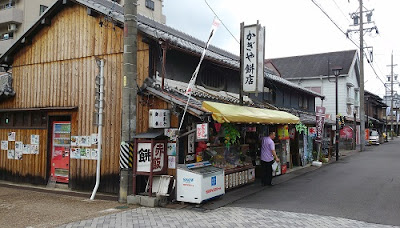
We went out the castle and strolled in the castle town. Then we found 'Shinobi-cho' there. 'Shinobi' is another way to call 'Ninja'. So, this area was a town Ninja families dwelled, who had been hired by the Todo clan. In the castle town, there aren't any moats. Furthermore, roads are changed quite violently.
By the way, we saw international tourists wearing Ninja costumes and Kimono. Because there are several rental Kimono shops where you can rent Ninja costumes and Kimono.
Now, we would like to investigate the Ninga. True charm of Iga Ninja is in suburb, we think. First, we want to introduce "Sawamura family mansion", a Hira-jiro castle or a castle on the plains built in the Middle Ages. Hira-jiro castles were formed like a rectangle or square in the plain land and at 4 ends of the site were covered by tall walls and deep moats. These were mansions of regional authorities and by some measures these were small castles. 'Sawamura family mansion' is in the east suburb of Iga city. The site is covered by 3 meters stone ramparts all around. And there was moats around it but these moats were reclaimed now.
This mansion is in the east suburb of Iga city. The site is covered by 3 meters stone ramparts all around. And there was moats around it but these moats were reclaimed now. The site is rectangle shape and big gate is in front of it. To the gate, there is a narrow and long approach and both sides of it is a wide rice field which it will change a muddy field in the battle time.
The site is rectangle shape and a big gate is in front of it. To the gate, there is a narrow and long approach and both sides of it is a wide rice field which it will change a muddy field in the battle time. We cannot see inside because of the stone ramparts. These seemed to be some buildings but we could see only the rooftop of the most outside residence. Backside of this property was a grove of mixed trees and also other residences covered its back, so we couldn't see inside from its backside.
As a matter of fact, this mansion is owned by a real Ninja's descendant. Someone of the Sawamura family at the end of the Edo era was a real Ninja and he searched the inside of a Black ship. This mansion is a true Ninja mansion.
Black ships: Western ships arrived at the end of the Edo era were called like this because of their body painted by tar.
We can see another Hira-jiro castle in a western suburb of Iga city. Its name is "Takeshima family mansion." Nobody lives now in it, and only a small information board in front of the gate notices that it's a historical building. Once it was covered by mounds and moats for defense, but these are removed and reclaimed now. However, its wide property is surrounded by a thick grove of mixed trees, so it stands out well in the vacant countryside. It seems to have reconstructed many times, but we feel the laden with history in it.

In the Sengoku era, the owner of this Hira-jiro castle was a member who battled against Oda Nobunaga. Was he Ninja? Maybe not. But several of his descendants were Ninja.
At east end of Iga city, there is the Kasuga shrine, and its front shrine is a building of the Kamakura period style. The construction date of it is unknown but was supposed before the Sengoku era. We heard that Kasuga-yama or the mountain in front of this shrine was the object of worship. When Oda Nobunaga invaded Iga basin, it was used as a mountain castle or a fortification. And there are remains of compounds and moats.
Original front shrine of it is survived for suffering the Oda's invasion. And one more strange thing is, very near, the Mibuno castle ruin is remained. This castle was used as a resistance base against Oda's invasion. In the ruin, there are tombstones of rural samurai people killed in this battle. So, we think the Kasuga-yama mountain was not used as a fortification when Oda's army invaded. We don't investigate deeply, but we come to think it would be used in another period.
We also find a notable temple, Tokuou-ji in the northern area of Iga basin, Marubashira area which is a border of Kouga district and Iga district. This area has an old tradition that Tokugawa Ieyasu took a short rest when he tried the "Iga-goe" trip.

The reconstructed main tower is also a historical museum like many other reconstructed ones. In it, there are many historical artifacts such as war helmets, armors and weapons. Actually, we hoped to find information about territory of this castle but couldn't find any. We supposed there wasn't remained documents or drawings any more.
 |
| The tallest stone rampart |
We have one thing specially wanted to mention, we can see the tallest stone rampart in Japan at the east bailey of the castle. Even though it's the tallest, it wouldn't be important. Because we have to take a roundabout route to this view point.

On the path to the stone rampart, there is the Iga-ryu Ninja Museum. It's a same kind of facility like the Kouga-ryu Ninjutsu-yasiki Museum we visited before. It was made earlier than the Kouga's, and we suppose the Kouga's was designed after this. We can look at the Ninja Show by Ninja performance group "Asyura". However, it was regular holiday. It's a pity that we couldn't look at it.
 |
| No performance show today |
We went out the castle and strolled in the castle town. Then we found 'Shinobi-cho' there. 'Shinobi' is another way to call 'Ninja'. So, this area was a town Ninja families dwelled, who had been hired by the Todo clan. In the castle town, there aren't any moats. Furthermore, roads are changed quite violently.
 |
| From a performance show another day |
By the way, we saw international tourists wearing Ninja costumes and Kimono. Because there are several rental Kimono shops where you can rent Ninja costumes and Kimono.

Now, we would like to investigate the Ninga. True charm of Iga Ninja is in suburb, we think. First, we want to introduce "Sawamura family mansion", a Hira-jiro castle or a castle on the plains built in the Middle Ages. Hira-jiro castles were formed like a rectangle or square in the plain land and at 4 ends of the site were covered by tall walls and deep moats. These were mansions of regional authorities and by some measures these were small castles. 'Sawamura family mansion' is in the east suburb of Iga city. The site is covered by 3 meters stone ramparts all around. And there was moats around it but these moats were reclaimed now.
 |
| Sawamura family mansion |
This mansion is in the east suburb of Iga city. The site is covered by 3 meters stone ramparts all around. And there was moats around it but these moats were reclaimed now. The site is rectangle shape and big gate is in front of it. To the gate, there is a narrow and long approach and both sides of it is a wide rice field which it will change a muddy field in the battle time.
 |
| The entrance of mansion |
The site is rectangle shape and a big gate is in front of it. To the gate, there is a narrow and long approach and both sides of it is a wide rice field which it will change a muddy field in the battle time. We cannot see inside because of the stone ramparts. These seemed to be some buildings but we could see only the rooftop of the most outside residence. Backside of this property was a grove of mixed trees and also other residences covered its back, so we couldn't see inside from its backside.
As a matter of fact, this mansion is owned by a real Ninja's descendant. Someone of the Sawamura family at the end of the Edo era was a real Ninja and he searched the inside of a Black ship. This mansion is a true Ninja mansion.
Black ships: Western ships arrived at the end of the Edo era were called like this because of their body painted by tar.
 |
| Takeshima family mansion |
We can see another Hira-jiro castle in a western suburb of Iga city. Its name is "Takeshima family mansion." Nobody lives now in it, and only a small information board in front of the gate notices that it's a historical building. Once it was covered by mounds and moats for defense, but these are removed and reclaimed now. However, its wide property is surrounded by a thick grove of mixed trees, so it stands out well in the vacant countryside. It seems to have reconstructed many times, but we feel the laden with history in it.

In the Sengoku era, the owner of this Hira-jiro castle was a member who battled against Oda Nobunaga. Was he Ninja? Maybe not. But several of his descendants were Ninja.
 |
| The Kasuga shrine |
At east end of Iga city, there is the Kasuga shrine, and its front shrine is a building of the Kamakura period style. The construction date of it is unknown but was supposed before the Sengoku era. We heard that Kasuga-yama or the mountain in front of this shrine was the object of worship. When Oda Nobunaga invaded Iga basin, it was used as a mountain castle or a fortification. And there are remains of compounds and moats.
 |
| Inside of the front shrine |
Original front shrine of it is survived for suffering the Oda's invasion. And one more strange thing is, very near, the Mibuno castle ruin is remained. This castle was used as a resistance base against Oda's invasion. In the ruin, there are tombstones of rural samurai people killed in this battle. So, we think the Kasuga-yama mountain was not used as a fortification when Oda's army invaded. We don't investigate deeply, but we come to think it would be used in another period.
 |
| Tombstones at Mibuno castle |
We also find a notable temple, Tokuou-ji in the northern area of Iga basin, Marubashira area which is a border of Kouga district and Iga district. This area has an old tradition that Tokugawa Ieyasu took a short rest when he tried the "Iga-goe" trip.
This trip is a very famous episode. When Oda Nobunaga was killed in Kyoto, Tokugawa Ieyasu traveled around Kansai area with his few retainers. He was in danger to be killed by his enemys, so he and his retainers intended to travel to his hometown. And this dangerous trip is called the "Iga-goe" trip.
When we actually observed it, we supposed that it might been used as a castle. So, we thought the tradition that Tokugawa Ieyasu took a short rest might be true. And the landscape around here suggests that this area was a defensive base of Iga basin. Furthermore, there were many small castles using steep mountain slopes around here.
 |
| Tokuou-ji temple |
Only one year before this episode occurred, Iga district had been completely destroyed by Oda Nobunaga's army. In this war, Iga's rural samurai group fought against Oda's army. They used "Norosi" or signal fire effectively. And when they attacked Oda's camps, they used guerrilla tactics under covered by night darkness.
This experience gave their descendants wisdom. And these techniques were used as the basic technology of the Iga Ninja.
A little after this war, Oda Nobunaga had been killed and the ruler was changed to Toyotomi Hideyoshi.
A little after this war, Oda Nobunaga had been killed and the ruler was changed to Toyotomi Hideyoshi.
We have no information about Iga district in the era of Toyotomi Hideyoshi. However, when the era of the next ruler, Tokugawa Ieyasu came, people in Iga district came to life again. Because rural lords of Iga district had helped Tokugawa Ieyasu's "Iga-goe" trip once. He owed them and he gave important positions to them. They were called Iga Ninja during the Edo period.


