Showing posts with label Festivals. Show all posts

2/09/2020

Red demons dancing festival

Red demons dancing festival


At one of typical rural villages in Japan, the village people won't like to be called like that, but the Toyone village is just the place. And, extremely unique festival is held every year. The festival is called 'Flower Festival' or in the Japanese expression, 'Hana Matsuri'. 


Village people wearing masks, or wearing traditional clothes dances in front of an alter. Every 2nd to 3rd of January, from 4 pm at 2nd to 3 pm at 3rd, almost 24 hours, the festival is held. From the first dance to the last dance which is held next afternoon, so many dances are demonstrated by a few dancers or at most 10 dancers. To our surprise, audience sometimes enter the dance performance. Because, for the village people, it's not appreciation but collaboration.


What kind of dances are displayed?

Its name 'Hama-matsuri' or a flower festival is so much different from our expression, they are demons' dances. The dancers wear 'demons' masks and costumes. This festival continues 24 hours, and it is consisted of a series of so many dances. So, sometimes cute children wearing beautiful costumes dance. 
And, other time, young adults or adult dancers continue to dance. Audiences are appreciating these dances, but we gradually notice they are waiting an appearance of the main dancers namely 'demons'. When a demon appears, audiences' attitude changes dramatically.


Once a demon appears in front of audiences, many demons join the circle of dancing people little by little. Demons' dances are mainly quite rough, and sometimes they stop moving and stare at the audiences. And other moments, they dance violently, and sometimes swing around axes. We are so much amazed, but village people know how demons behave and they act the next moment. They approach close to demons sometimes, and when demons dance aggressively, they keep a distance from demons. Because they experienced many festivals, so they know what would happen.  


This festival is continuing at a very few communes in the Toyone village and the Toei town. These communes have facilities for the festival in each domain. 
In the center of the facility, approximately 5 meters to 5 meters earth floor named 'Maido' is placed. In this place, ceremonies and dances of 'Hama-matsuri' are displayed. At the very day, a big cauldron is placed at the center of this place and water in it is boiled by a bonfire. Surrounding area is dancing space, and audiences seem to be prohibited to enter this area. However, after the festival continuing, many villagers enter this area, so there would be a kind of unspoken rule. 


A big cauldron is placed in the center

According to a tourist guiding brochure, festival ceremonies are held as follows. The first dance named 'Jigatame' or 'Preparation' tells the start. And, other dances mainly consisted of several youths continue one after another. In other moments, young children dance lovely with the help of adults, who just entered an elementary school or belong to a kindergarten.

At times, audiences join the performances. Furthermore, sometimes dancers interact with audiences. For example, dancers hit audiences with huge 'Sakaki' leaves during a dance, in this timing, villagers get their arms around the situation. They gather into the ground and are willing to be beaten by the leaves. This action is supposed to be a spelling for good health or something like that. There isn't any explanation out there. By contrast, villagers comprehend by tacit understanding. We wonder how this festival cooperates with villagers' life. 


Dancer hits audiences

Meanwhile, many villagers surround the dance field, and it becomes difficult to find the dancers. We find a dancer wearing red clothes, and he has demon mask! It seems like villagers hide demons behind them from true tourists like us. Demons have several characters and they perform differently according to their characters. However, first appearance of a demon is midnight, we can't wait for every demons dancing. So many tourists already give up to wait the appearance of demons. We are even better than them, but we also give up the tour when we find several demons dancing. 

After that, according to a guide book, demons exchange questions and answers with villagers. And, hot water in the cauldron is sprinkled, and Japanese traditional lion dance is performed. We leave the festival site before these ceremonies.


Why they call it the flower festival?

We find an answer, village people might not agree our opinion, but....
'Flower' means their children. There are many specious logic, but their only purpose for the festival is to show off their children dancing in front of men of influence in the village. This understanding is very personal and not authorized.  


Young children's dance

This festival's heroes are demons, but many of them are kids demons. When we investigated several academic books, this festival is related to monks training in the mountains. Villagers reproduced these mysterious monks as demons, some demon had good character, and others tried to exchange questions. 
According to one authority, this festival had been held approximately 600 years ago. And around 100 years ago, an academic survey was conducted in these communes, and Japanese people paid great attention then. However, time goes on, contents of festivals would be changed now.  

Youths' dance

It's hard to visit the Toyone village in Aichi prefecture. When we travel from Osaka, we use the Shinkansen super express from Shin-osaka station to Toyohashi station. Travel time of this line is around 100 minutes, and frequency is 2 lines an hour.

Up to this station is fine, but the next train does not arrive at our destination. 
We have to get off the train at midway point named 'Urakawa' station, and there is no train available any more. So, as an idea, we will call a taxi instead. 
Travel time from Toyohashi station to Urakawa station is also around 100 minutes, but frequency is almost 1 line an hour but a little bit more less.

Whatever we start early morning from Shin-osaka and choose better trains, we may arrive at Urakawa afternoon. Moreover, if we find a taxi soon, we need an extra hour to arrive our destination. This village is located quite far from the train line.


Mysterious name and quite unique demon masks have taken on a life of its own. Actually, very few people know how the festival is held. No wonder about that. Traveling time to the destination would be a little over half day, the festival starts at night, it continues all night long, and the main event starts midnight. Furthermore, there is no accommodation near the facility for the festival. Visitors should stay up all night. If they conserve their power, there would be another long time trip go back to their home. 

One more thing, this festival is held at the beginning of January, so the temperature of the midnight time is severe cold especially in the mountainous area. 

This phantom festival is still untouchable for ordinary people.


3/21/2019

Iga festival

Iga festival


Revisiting Iga-ueno city, we looked around the museum named 'Danjiri Kaikan'. We learned an amazing festival in which a hundred and more ogres and demons walked around streets of Iga-ueno city. In more detail, we'll explain below.


The festival is held in every second half of October. We can confirm the date when the festival is held by website. And it continues 3 days. Its feature is a parade of 'Mikoshi', 'Oni-gyoretsu', and 'Danjiri'. 'Mikoshi' is a portable shrine, and we already met at Hiyoshi-taisha shrine (refer to an article 'Armed priest'). 'Danjiri' is a float, please remember 'Inuyama festival', we saw many floats there (refer to an article 'Inuyama festival'). Maybe it's not so important, floats of Japanese festivals have several names, so 'Dashi' in Inuyama festival is same as 'Danjiri' in Iga festival. These 2 items are regular members in a lot of Japanese festivals.


at 'Danjiri Kaikan'


at 'Danjiri Kaikan'

However, 'Oni-gyoretsu' is not usual. 'Oni' is an ogre, and 'gyoretsu' means 'parade'. Why ogres parade in a festival? They put masks of numerous types of ogres, and wear a variety of traditional costumes. They look like 'zombie' people. 'Danjiri' was developed affected by the Gion festival in Kyoto, but the origin of 'Oni-gyoretsu' is in a sealed book. 
 
from HP of this festival
 
from HP of this festival

This festival is officially called 'Ueno tenjin festival'. Its origin is around 12 centuries, so quite long history it has. When Oda Nobunaga invaded Iga district, temples were destroyed, and this festival also ceased. In 1611, Todo Takatora, one of famous Sengoku lords became a lord of Iga district. He decided to reflourish the 'Ueno tenmangu' shrine. Then this festival was revived around 1660 in the early Edo period.


You can find what is 'Omikoshi' or a portable shrine from an article 'Armed priests'


You can find what is 'Yama' or a float from an article 'Inuyama festival'


4/15/2018

Inuyama festival

Inuyama festival


The gist is as follows:

1. An overview of Inuyama Festival
2. Dedication of Karakuri dolls' attraction as the main daytime event
3. The nighttime event completely different from the daytime one
4. When and how it has begun


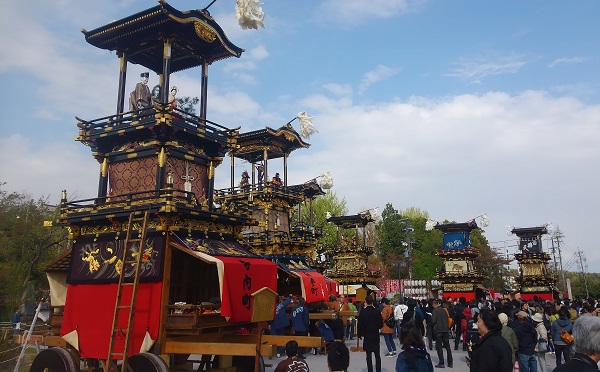
The Inuyama festival is one of traditional Japanese festivals, and held at Sat. and Sun. of the 1st week of April every year. Main attraction is a parade of 13 cars of "Yama", floats. They are 3-storied and over 8 meters high, and the fronts of them are decorated by beautiful engravings and embroidered thick curtains. During the festival, they are dragged around the central city area of Inuyama by the participants dressed special festival wears.

In addition, Karakuri dolls, traditional mechanical dolls are settled on the top floor of the floats. These dolls are operated by several participants inside them, and the dolls act miracle performances. It's called dedication of mechanical dolls, and it's held at the plaza in front of the Haritsuna shrine and Inuyama-ekimae plaza. Each performance fascinates people watching them. Then so many viewers gathered to watch them during this festival days. And also it's held just in full bloom of cherry blossoms, which serves as a foil of it every year.

Daytime "Yama" (floats)

The festival is broadly divided into daytime programs and nighttime ones, and daytime events are roughly continuing like below. First day's morning, 13 floats which stored each towns' store houses head towards the plaza in front of the Haritsuna shrine. Because this festival is the shrine festival of Haritsuna shrine, so, they gather firstly in front of the shrine. Half of the floats move to another meeting place, the front plaza of Inuyama station, just past noon, and the other half stay still there.

At two places, the plaza in front of Haritsuna shrine and the open space in front of Inuyama station, each Karakuri dolls of floats present their performances. Karakuri dolls are equipped with the highest places of each floats. And these performances are original in each floats, and these are continuing for 10 to 15 minutes. Each Karakuri dolls wear beautiful clothes and act variety actions. We can see them moving, but can't find where puppet wires or other ingenious devices are hiding. These performances are the main events of daytime programs and named the Karakuri doll dedication. 

Each Karakuri dolls play a skit like bellow. One Karakuri doll goes up the separated 5 to 6 pillars of steps. He raises his right foot on the first pillar, and the next moment, he stands on the pillar by his one foot. And the next time, he raises his left foot on the second pillar, and stands on it by his left foot (another foot is floating in the air). Then the third, and the forth, and finally he grasps a scroll on the ceiling which is placed very high point the Karakuri doll can't grave at his starting point. These pillars keep at distance, so we can't guess where the devices are hidden just by looking at. 

The shape of the float is like stacked 3 boxes and it has 4 wheels and pulling rods in front of it. About 10 adult people gather around the float and they move it. They also rotate this heavy stuff smoothly with its one wheel as a shaft when it changes the course at crossings. Inside of it, there are 7 to 8 children dressed colorful festival wears sit crowd together and perform instruments such as Japanese traditional flutes and drums. Sightseers are captured by their lovely performance. 


Night version

Now, night falls, the floats change their appearance dramatically. Participants of the floats put many sticks dangling total 365 lanterns on the decorative handrails all around of them. In every lantern, a candle had been set before. Lanterns are lightened when the evening deep ultramarine gloom changes the deep blacken night. Then, the floats change into growing massive moving-objects.


The floats wrapped yellowish-growing lanterns stroll around the central city. Each side of the main street where many floats go back and forth is occupied by festival stalls. These streets are covered by a huge amount of festival viewers, and brights from colorful stalls of food, souvenirs, toys and so on all night long.

We chase one float slowly, because there are so many people around us. We can't move when the float takes a short rest, then we also take a rest and look around several festival stalls in front of us. But it's also the fun of the festival night. 

The next day is also same. If you want to appreciate every must-see attraction, you have to stay in the town all day long. However, they separate several time zones, so you can visit other features of this town in pockets of time. Because this city is the width you can travel about by foot. For example,visiting Inuyama Castle main tower, tasting Japanese tea and sweets at tee parlors along the street are recommended.


The history of Inuyama Festival

This festival is the shrine festival of Haritsuna Shrine. Haritsuna Shrine was founded on the hill where Inuyama Castle is situated now. It had been a long time before the castle was made. But during the Sengoku period, Inuyama Castle was made on this place, so the shrine was moved to another hill. When the Edo period began, the castle town was renovated on a large scale, and as part of the renovation, the shrine was moved again to a corner of the newly renovated castle town.

It is said that the festival started in 1635, approximately 380 years ago. When this shrine made the first event, it was located in the town and floats gathered from towns surrounded it. By contrast, it is in halfway up the castle hill now. This relocation was carried out at the beginning of the Meiji period, only 130 years ago.

The first idea of this festival was an imitation of the Owari-toshogu Shrine's in Nagoya city. In the Edo period, there was a very important Han (that was kind of local government). That was called the Owari Han, and Owari Tokugawa clan succeeded the status as the leader of it. They were the relatives of Tokugawa Ieyasu, and when he died, they enshrined him as a god. It is said that the Owari-toshogu Shrine's god is Tokugawa Ieyasu. And its shrine festival was started to memorize him. And also it was said that "Yama" or floats paraded to warm up the festival.


The lord of Inuyama Castle held an additional post as a chief retainer of the Owari Han. So, he carried out the same festival, because maybe he wanted to follow what Owari Han started. The Haritsuna Shrine was selected as a suitable shrine, and ordered to start the festival.

Long years had passed from the beginning of both festivals, every "Yama" float of the Owari-toshogu shrine was burnt by the disasters of WW2. By contrast, 13 "Yama" floats on the Inuyama festival were inherited until now. The floats themselves were made in the middle of 19th century or after, so, they were not so much old enough.

Most "Karakuri" dolls were made in the later half of 18th century. We think they were pioneers of robots. At "Shiro-to-machi museum Donden-kan", you can see "Yama" floats and "Karakuri" dolls. 


5/16/2017

Arquebus 3

Arquebus 3


Nagashino battle standard festival

"Nagashino battle standard festival" started half-century and a few years ago. It might belong to the category of new ones just getting started.

We don't think this festival is famous around Japan. Neither not famous among international tourists. If someone already knows, he might be a big fan of Japanese festivals or he lives near "Nagashino" town now.


Nagashino battle standard festival

And, you need one more information. If you don't know the Battle of Nagashino in 1575, it's difficult to understand why Arquebuses are fired in this festival so many. Many fake Samurai warriors wearing armors gather in this festival site. They are who belong to several Arquebus-shooting groups and these groups play shooting-performances of Arquebuses all day long. Because this festival features the Battle of Nagashino, the battle Arquebuses played a very important role.

To say precisely, the incident drawn on "the folding screen of the Battle of Nagashino" wasn't happened here. Because this famous battle happened at the two main battle-fields. And the Nagashino castle was one of them which is the event site of this festival, however, the battle drawn on the folding screen happened at another battle-field.


Strands are everywhere

This battle separated to the former part and the later part. The former part was the siege of Nagashino castle, and the later part was the field-operations at Shitaragahara. In this field-operations, guns were used collectively never before. As a result, this tactics became very famous. However, that is another story.


Nagashino castle ruins

Now, we would like to look back over the history of Arquebuses quickly. The principle of matchlock guns was invented in China. But, practical invention was attained by some Europeans. By the description of an European historian, matchlock's anchor-hold and mobile-power weren't so superb than other traditional ordinary weapons first.

Nevertheless Europeans improved and refined their new weapon for many years. And, finally they made this new weapon assuring safe operation.

Why they put up with the inconvenience? That's because when this weapon was used, the user army troops needed less further extra practice to put into real battle field. When some army troops brought up their new arrow-soldiers, they needed a few years. By contrast, to bring up musket-soldiers, they only needed a few days!

Opening ceremony (shinshiro city HP)

On the contrary, Japanese didn't understand this most important point of using musket guns. Unexpectedly, they established new Budo named Hou-jyutsu. They chose the way of practicing new musket-soldiers in which they spent long and strict time until the completion of their study. If the battles continued, this decision was denied by the employers. However, battles were over so the decision was agreed.

Japanese couldn't improve musket's power in the technical aspect. Then they developed their weapons strangely. For example, they thickened the body to improve the power. The result showed that musket-soldiers had to bring very heavy muskets and they could not move quickly. So, some soldiers couldn't operate these weapons. As for the operations they had to practice their physical strength and used weapons with predefined actions.


Performance of Arquebuses

"Yonezawa-han Koshiki-jyu Hozonkai" is a group of the descendants of Yonezawa-han's Houjyutsu-ka, who attend this festival over half a century. Their special Arquebuses are over 20 kilograms. Furthermore, reaction force are awful as strong as the power to make shooter's shoulders broken when they don't behave correct performance.

Big size Arquebus (Shinshiro city HP)

We think these Arquebuses aren't useful for the action in the real battle field. However, their ancestors used these weapons in the very famous war named "the Siege of Osaka castle" in 1615.


Practicing of their physical performances and having great passion are behind the performance. It is
 very typical Japanese approach.


The venue and the festival schedule

We're sorry to do a little top-heavy explanation. Let's go to the festival place.
The main event site is Nagasino castle ruins. It's in Shinshiro-city Aichi-prefecture, same as "Shitaragahara historical museum". The traffic route is also same, you should ride 2 more stations, and you can arrive the place named "Nagashino-jo".


Running in board

The distance from the station to the event site is approximately 10 minutes by walk. You attend the festival now, then you can follow other audiences of the festival. You may reach the event site easily.


Festival schedule is below.
It's almost same every year.

The date of the festival   May 5th
Relevant events are held on May 3rd and 4th, but performances of Arquebuses are only 5th.


"Kattsen-Gyoretsu" or the parade   9:30 a.m. to 10:45 a.m.
Many attendees wear fake Samurai battle armors   

Only some votaries and local people go to see the parade, and other people wait the arrival of the parade at the event site. 

Performance of Arquebuses 1   9:30 a.m. to 10:00 am
This is the event for the people wait the starting ceremony.

We tried to visit there at the starting time of  this performance, but it's too difficult to make this timing. Because, you have to ride JR local train from Toyohashi-station to Nagashinojyo-station for approximately 1 hour. You may ride a train at Toyohashi-station around 8:30 a.m.. Accordingly, you have to leave Osaka-station very early in the morning.


Kassen-gyoretsu (Shinshiro city HP)

Ceremony   10:45 a.m. to 11:20 a.m.

Performance of Arquebuses 2   11:30 a.m. to 12:00 a.m.

Performance of Arquebuses 3   12:00 a.m. to 12:30 a.m.

Performance of Japanese Archery by wearing battle armors   12:30 a.m. to 01:00 p.m.

Performance of Arquebuses 4   01:20 p.m. to 01:50 p.m.

Performance of Arquebuses 5   01:50 p.m. to 02:20 p.m.

Performance of Arquebuses 6   02:30 p.m. to 03:00 p.m.  And, Finishing of the festival

Scenes of Ceremony


Performance of Arquebuses

This festival is featuring the battle famous for the big success of Arquebuses. Therefore, almost all performances are shootings. The performances are held 6 times by next 3 groups 2 times each.


"Nihon Zensoujyu-shageki Renmei"
or Japan muzzle-laders associations committee

"Yonezawa-han Koshiki-jyu Hozonkai"

or the traditional gun-performance association of the feudal domain of Yonezawa
 
"Nagashino Shitaragahara Teppou-tai"

or the musket troops of Nagashino and Shitaragahara region

 
Today's event site isn't wide enough, so musket troopers separated small groups. Whole members unison-firing weresn't practiced.


On the other hand, we had seen about 10 troopers unison-firing at another festival of Okazaki-city. Compare with it, today's festival was held at closer range than Okazaki-city's. We felt strong live feeling by tremendous gun-sound! 


Performance of archers

Between 3rd performance of shooting and 4th, archer's performance was demonstrated. Archers released arrows practically. Besides, musket-gunmen didn't fire true bullets. Taking these things into consideration, we preferred to archer's performance instead.

Furthermore, musket-gunmen seemed to use kind of modern contraptions, that hadn't existed in the Sengoku era. Even that small difference made us spoiled the fun of Arquebuses.

2 to 3 minutes were necessary for musket-gunmen to prepare the next firing, even though they used such kind of modern contraptions.


They performe wearing armors

For archers, only bows and arrows were necessary in the battle field. But, for musket-gunmen, muskets and bullets were not only necessities, they needed other many little items, for example fire starters, gunpowder cases and so on.

items necessary for gun shooting

Each item was not so difficult to handle, but if you forgot to bring, dropped, or broke them, you couldn't fire your musket. Thus, musket-gunmen sharpened these items and came up with using the skills not to fail in the battle fields. However, the idle time after the first shot to the next wasn't shortened by their innovations.

We could meet performers by chance

By contrast, less than 30 seconds were needed for archers to switch places with the first group and the second one. And also there were no idle time between the first shot and the next in their unison-releasing. The targets were soon filled with arrows. However, the distance to the target was only 20 meters. So, we supposed the conditions were a little advantageous for archers.

We could see armored people closely

The event site was an empty space where was filled with the carpet of green grass and no buildings. There were only performers and audience. Gentle breezes and mild weather made us satisfied. It was a really beautiful festival day!