5/02/2022

Rise of the Muromachi 1

Rise of the Muromachi 1

The Muromachi (室町) era (1338-1573) has a dubious reputation when comparing other eras in Japan. At the same time, the Sengoku (戦国) era and the Azuchi-momoyama (安土桃山) era are quite popular, which are overlapping in the latter part of the Muromachi era. Why such difference exist? We can't put our fingers on it now. So, we would like to find the reason below.


The Myoshinji temple


Let us clarify the fact that in the era between Sengoku and Azuchi-momoyama, depressed mood in the Japanese history was changed and something energetic was flourished. 

If we dare to look for a comparison target, the Renaissance period in European countries would be. We believe its popularity is caused by the fact new energetic mood was flourished in this period. Furthermore,  we don't know in detail but the previous period might be unpopular.


Now, we would like to clarify a couple of reasons why the Muromachi era is unpopular. 

The first target is the abstruseness of the reasoning of the incidents happened during this era. 

Why the definitive events happened or why the current of Japan's history brought the Muromachi era after the Kamakura (鎌倉) shogunate? We suppose any researchers can't unravel the sealed book of the birth of this era. 

The second target is the confusing structural-outlines who battled against who. Right after this information, we would like to describe biographies of the main characters and opposite relationships. In this article, the main focus is there. 

The third target will be the lack of information about the war of this era. For example, preparation and progress of wars, ability and tactics. We know the war in this era was different from the war in the Sengoku era. Because we are more familiar with this information by looking at historical dramas or reading historical novels. However, we don't know the difference in detail. We would like to mention our ideas in the next article in the current schedule.


The shokokuji temple

Let's get started with the explanation of the confusing structural-outlines. Until a while ago, we learned like below. Before the beginning of the Muromachi era, there was the Nanbokucho (南北朝) era (the era of the Northern and Southern courts). And before the Nanbokucho era, there was the Kamakura era. However, we would like to mention there was no reality to the situation of the Nanbokucho era. 

In our understanding, there were the Kamakura era, chaotic time and the Muromachi era in sequential order. Firstly, there was the Kamakura era when the Kamakura shogunate had the politic power and govern the whole country. Secondly, there was a chaos when the person who had the politic power changed frequently. And finally, the Muromachi shogunate had the politic power and govern whole Japan. Then, we will describe the confusing structural-outlines at the beginning of the Muromachi era in sequential order.


The Muromachi era began at 1338 when Ashikaga Takauji (足利尊氏) was designated as the first shogun and established a new shogunate. We would like to call the year as "Muromachi 0." The Kamakura shogunate had been destroyed at 1333, "Muromachi -5." At this time, the Kamakura shogunate was governed by the Hojo family and the Ashikaga family was one of their subordinates.

At the same time the Emperor Godaigo (後醍醐天皇) who headed the Imperial Court in Kyoto struggled against the shogunate already for several years. The trigger of overthrowing of the regime was the betrayal of Ashikaga Takauji. This was namely Ashikaga Takauji turned over to the Emperor Godaigo side. And soon after the incident, Kamakura was attacked by the alliances' army and the Hoyo (北条) clan was killed there. Then the Kamakura shogunate was destroyed and the Emperor Godaigo took the politic power.

In this situation, the opposing structural-outline was the Hoyo clan versus the Emperor Godaigo. As to Asikaga Takauji, he belonged the Hoyo clan's side before 1333. And at 1333 he changed his situation to the Emperor Godaigo's side. It was very important for the victory of the Emperor Godaigo's side, however, Ashikaga Takauji was not allowed to be the shogun. At this point, he was only a subordinate of the Emperor.

History of this period was handed down by the Senki-mono (戦記物 = battle tales). Which was not a real history book but a story book in which many fiction were written. For that reason, it was difficult to make sense and several facts were distorted for fun of the story. People who were loyal to the Emperor Godaigo such as Kusunoki Masashige (楠木正成) and Nitta Yoshisada (新田義貞) were excessively highlighted.

On the contrary, Ashikaga Takauji was underestimated because he betrayed the Emperor Godaigo in the next situation. Even so, he had quite high historical-significanse. We have to notice and avoid this trap.

The Emperor Godaigo was the existence beyond human understanding for these historically famous people at that time. Ashikaga Takauji, Kusunoki Masashige, Nitta Yoshisada and other people always obeyed this imperial majesty. However, for Ashikaga Takauji, devotion with all his heart and soul was a wasted effort. Because the emperor neglected him. So he had no alteration except for betrayal.   


The Emperor Godaigo


The next opposing structural-outline was Ashikaga Takauji plus Ashikaga Tadayoshi (足利直義) versus the Emperor Godaigo. This situation started at 1335, "Muromachi -3." Around this time, Ashikaga Tadayoshi was noticed as a key person. He was a younger brother of Ashikaga Takauji and this brother began to fight their own battles from this time.

As the result of this confusing, Asikaga Takauji and Asikaga Tadayosi killed Kusunoki Masashige and Nitta Yoshisada who belonged on the Emperor Godaigo side. According to this result, the Emperor Godaigo left Kyoto (the center of the court) and moved to Yoshino (吉野) in Nara Pref. (奈良県).

Depending on this consequence, the other Emperor enthroned and dominated the court. However, the Emperor Godaigo still existed in Yoshino and continued his political action. So, there were two courts in Japan at this time. Historian named the situation, "Nanbokucho (the Northern court and the Southern court)." If we are particular about the details, the Nanbokucho started at 1336, "Muromachi -2."

The Emperor Godaigo died there at 1339, "Muromachi +1." His group continued their struggles against the administration of Ashikaga Takauji, however, the difference of the power was quite obvious.


Kono Moronao
The opposing structural-outline after that was Ashikaga Takauji plus Kono Moronao (高師直) versus Ashikaga Tadayoshi. This situation started at 1349, "Muromachi +11." Around this time, Kono Moronao was noticed as the next key person. He was the butler of the Ashikaga clan. However, we suppose the butler in the Japanese history and the one in Europian countries is different. In other words, he was the top retainer of the Ashikaga group.

In the previous year, his army fought against Kusunoki Masayuki (楠木正行)'s army. Kusunoki Masayuki was an important and high class warrior of the Emperor Godaigo's group. Kono Moronao's army won the battle and killed Kusunoki Masayuki, so, his position in the Muromachi shogunate was highly uplifted. 

Around this time, Ashikaga Takauji, the first shogun appointed Tadayoshi as the administrator of full power. Several dissatisfied subordinates tied to Kono Moronao. Asikaga Takauji hoped to avoid the battle against his younger brother. All his hope was in vain, they began to conflict with each other.

At 1351, "Muromachi +13," Ashikaga Takauji and Kono Moronao allied forces fought against Ashikaga Tadayoshi's army. The allied forces were defeated. After that, Kono Moronao and his clan were killed.

The conflict continued further, and the next year, the position was reversed. Ashikaga Tadayoshi surrendered to Takauji and soon after that, he died (the cause of death isn't clear, maybe killed maybe died from illness). Ashikaga Takauji died at 1358, "Muromachi +20." His son, Ashikaga Yoshiakira (足利義詮) became the second shogun. After that, although the generation changed, the conflict between the Southern court and the Northern court continued until 1392, "Muromachi +54." 


As we mentioned above, there were three major conflicts. According to that result, the politic power who took over the reins of government was changed frequently. It's too difficult to catch up with the alterations. Furthermore, battle fields extended various places. For example, the eastern area such as Kamakura and base cities up through Kamakura. Dazaifu (大宰府) where was the administrative center of Kyusyu (九州) area and base cities up through Dazaifu. Moreover, the Tohoku (東北) area and Kii (紀伊) peninsula where the strong bases of the Emperor Godaigo group existed. 

We suppose the lack of stability and dynamism of the Muromachi shogunate caused the unpopularity of it. Because we expect such kind of things for something newly born.


Toyotomi Hideyoshi
To close, we would like to compare the beginning of the Muromachi shogunate and political power during the Azuchi-momoyama era. During the later period, the three heroes, Oda Nobunaga (織田信長), Toyotomi Hideyoshi (豊臣秀吉) and Tokugawa Ieyasu (徳川家康)were active. At first, Oda Nobunaga destroyed the Muromachi shogunate. And after the death of him, Toyotomi Hideyoshi established his government. However, his government perished in one generation and Tokugawa Ieyasu established the Edo shogunate which lasted a long time. If we compare these two, it will be a little too much biased, however, we believe you will find something which we hope to report.

We will set the timing when Toyotomi Hideyoshi destroyed the Hojo clan, 1590 as "Momoyama 0." We will describe the history quickly below. At first, Oda Nobunaga destroyed the Muromachi shogunate at 1590, "Momoyama -17." And, he was killed by one of his retainers, Akechi Mitsuhide at 1582, "Momoyama -8." At 1582, "Momoyama -8," Toyotomi Hideyoshi and Tokugawa Ieyasu battled directly. At 1586, "Momoyama -4," they became related by the marriage of Tokugawa Ieyasu and Toyotomi Hideyoshi's younger sister. Then Tokugawa Ieyasu became a vassal of Toyotomi Hideyoshi. 

We will overlap Oda Nobunaga and the Emperor Godaigo. And we believe that we get a deduction below. The Emperor Godaigo destroyed the previous government 5 years before the establishment of the next government which was established by Ashikaga Takauji. Oda Nobunaga destroyed the previous government 17 years before the establishment of the next government which was established by Toyotomi Hideyoshi. Each of them disappeared in the short term and their successors flourished the new governments.

In the case of Ashikaga Takauji, he was disliked by the ruler of the previous government. And he unwillingly changed his situation to the opposite side. In the case of Toyotomi Hideyoshi, at first, there was the death of the ruler of the previous government. And he won the battle of the potential successors. So, in this comparison, there will be unreasonableness to gain a deduction. 


Tokugawa Ieyasu
Then, can we overlap someone to Tokugawa Ieyasu? There will be two people, Ashikaga Tadayosi or Kono Moronao. However, Ashikaga Tadayoshi was a younger brother of the rival, so, we will choose Kono Moronao. In the case of Tokugawa Ieyasu, he was very clever and he waited until his previous ruler died from illness. Toyotomi Hideyoshi died at 1598, "Momoyama +8." (Ashikaga Takauji lived until 1358, "Muromachi +20," so, Hideyoshi's ruling time was comparatively short.) And Tokugawa Ieyasu established his shogunate at 1603, "Momoyama +13."

On the contrary, Kono Moronao climbed the ladder and reached one step behind the success at 1351, "Muromachi +13." And he defeated and died then. From this consideration, we may get an outlandish deduction that finalists become active after the establishment of stop-gap authority. Because "after 13 years" matched by chance in this article. 


We described very high-handed measurement, but, we believe we have gotten the deduction below. 

Very popular Azuchi-momoyama era and very unpopular Muromachi era is not all that different. For example, composition of main characters, developments of important incidents and flows of historical progress. Such kind of things is quite similar.

Up to this point, we have considered our second guessing is correct or not. The guessing is that confusing structural-outlines who battled against who is the cause of unpopularity of this era. However, we have found the conclusion it wasn't true. So, we would like to consider our third guessing is correct or not in the next article.


4/06/2022

L L B C (4) Cherry Blossoms

 🗾   L's Life in a Big City  (4) Cherry Blossoms  🗾


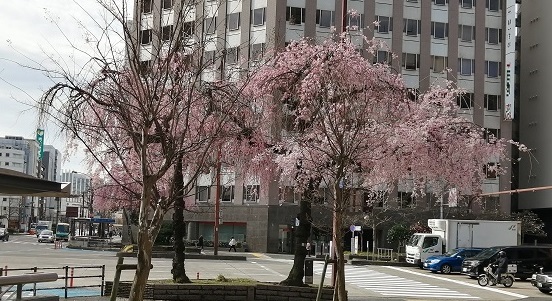
Two cherry trees are there beside an entrance-exit of a subway station. These trees are becoming to full-bloomed nowadays. (I took this picture at March 27th.) So, I feel appeased nowadays too. 


The custom of cherry-blossom viewing has a history of over a millennium. The signatures were, for example, in some Waka-poems' anthologies. By the way, the Muromachi Shogun's residence in Kyoto was known as the "Hana (flowers)" Palace. Speaking of "Hana (flowers)", I remember cherry-blossom. Well then, were there any relationships between the "Hana (flowers)" Palace and cherry-blossom? (A supplementary note: I'm talking about a history during the Muromachi period (1336-1573).)


We have already uploaded a couple of articles. If you want to find additional information, please visit there.

Temple of Shogunate 1

Temple of Shogunate 2

Temple of Shogunate 3


There are some theories about the name of the Palace. One theory is that the owner, the second Shogun (Ashikaga Yoshiakira) bought this premise from a nobleman and the name was the "Hana" residence. Unfortunately, according to this theory, there wasn't a relationship between the "Hana (flowers)" Palace and cherry-blossom. According to another theory, the reason for the name is that many beautiful flowers were planted in the garden of this Palace. Then, people at that time called the "Hana (flowers)" Palace. And, there was a some type of cherry-blossom tree (weeping cherry tree) I saw beside an entrance-exit of a subway station. (There is a description about the weeping cherry tree in the "Hana (flowers)" Palace in a diary written in the early Muromachi period.)  


I overheard that the temperature of Japan is rising year by year. And, if the trend continues, the blooming of cherry trees' flowers would not occur. Because cherry-blossom comes out only when the cherry trees spend the cold in winter and face to the sudden changes in temperature in spring. They say if the Global Warming continues furthermore, cherry-blossom trees wouldn't grow in Japan anymore. The custom of cherry-blossom viewing is essential for Japan's spring. I very worry about this point.


3/30/2022

L L B C (3) Star Trek !?

 🗾   L's Life in a Big City  (3)   Star Trek !? 🗾


I would like to introduce a little more about the event square I mentioned in a last article. When I saw it from this angle, I thought it was the Spaceship Enterprise landed on the earth.


The massive oblong roof is named "Water Spaceship." So, I became convinced of influence of the Star Trek. I believe this structure's design was inspired by the Spaceship Enterprise.


In the center of the Water Spaceship, there is a huge basin or actually a pool. And, under the water you can look down the event square.


The event square is placed underground level and the massive roof is on the third floor of this structure. So, the large space can be used for the large scale event.


This structure was built in 2003. This year is the 20th anniversary for it. And in addition, in this place, the World Cosplay Summit is held every year.


3/27/2022

L L B C (2) Spring storm

 🗾   L's Life in a Big City  (2) Spring storm  🗾


This time, I'm planning to tell a little about "Spring storm." The day I took these photos, March 26 was a day rain and wind were strong all day long. It's rare to see this weather this season.


By the way, I got the word that a weather like this was described "Spring storm."  And I learned "Spring storm" was one of meteorological words in Japan. It means a weather condition that low air pressure grows and a rain storm develops especially during March to May. It's not so popular but when I heard this technical word I didn't feel the uncomfortable feeling against the unfamiliarity. 

More than that, I imaged a relationship between the word "Spring storm "and a literary work. Because there is a famous novel named "Spring storm" in Japanese translation. That is "Geryrud" written by Hermann Hesse (1877-1962), a famous Swiss novelist. And I suppose I'm influenced by the image of this novelist. You may think you don't know who Hermann Hesse is! To tell the truth, I haven't read "Spring storm" or "Geryrud" written by Hermann Hesse. I'm not so exactly remember the days' of my elementary school or my junior high school, but I believe I read one of Hermann Hesse's stories then. To a sensitive young, Hermann Hesse expressed a strong influential power. So, one of meteorological words also inflames my imagination.

Now, people in downtown feel daily life after March 21 when the covit-19 restriction was narrowed a little. This scenery was an event square downtown. Rain and wind were strong all day long but people were coming back!


3/24/2022

L L B C (1) Poster

 🗾   L's Life in a Big City  (1) Poster  🗾


For a while, one of us will report one's everyday life. And, we want to name this report "L's Life in a Big City." It's an extra edition until being eased the coronavirus restrictions. In "L's Life in a Big City", L will capture moments of L's usual life. The first report is a photo in a train carriage. Here we go.  


This photo is an ad of a university recruiting students. If you can read Japanese, you will understand which faculties are recruiting now. "環境科学部" literally means "Environmental science faculty" and "心理学部" means "Psychology faculty." Of course I'm interested in "Environmental science faculty," but this time I'll cover "心理学部." You can see a photo of a man standing beside a car. He's using the police radio and a Kojak light is placed on the car's roof. This image is describing the result of studying in "Criminal psychology department" or "犯罪心理学科." Then, why this photo symbolizes "Criminal psychology department"?

You can find many detective TV dramas even in Japan. There are several ways of stories. And "crime scene investigation police dramas" are very popular, which are only adaptations of the American TV series. In these dramas, heroes hunt down criminals using their sharp insight especially "using psychological approach." I think several "Criminal psychology departments" are already existing in traditional universities. However, this university is going to start the department now. Because they think criminal psychology is a theme which is worth learning for the youth aiming for universities now. And they are dreaming getting such kind of jobs in the future. Moreover, they may think they become cool detectives.  


12/05/2021

One more survived inn town

 One more survived inn town

We once visited two nostalgic inn-towns, Tsumago(妻籠) and Magome(馬籠) where many historical buildings are survived. The inn-towns were located in the Nakasendo(中山道), an ancient highway made in the early Edo period.

And also these were 42nd and 43rd inn towns from Edo(江戸) city. These highways not only this Nakasendo but also numerous other ancient highways were developed dramatically. Roads were widened and surfaces were changed into asphalt.

Because modern society needed the changes. Speaking of the Nakasendo, only 42nd and 43rd inn-towns were survived. These towns were relatively inconvenient for the modern people's transfer. New route was developed and these inn-towns were isolated. 


Is there any survived inn-town? 

Clue to the investigation is to focus on highways made in the Edo period. We once mentioned that the most famous highways between Edo and Kyoto(京都) were two. These were the Tokaido(東海道) along the coastal area and the Nakasendo in the inland area.

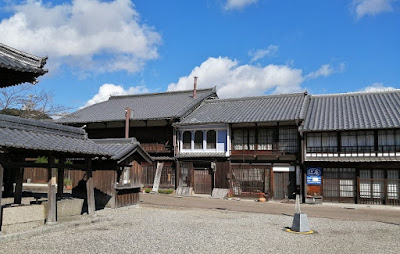
And this time we found that another inn-town in the Edo period is also survived in the Tokaido route. That is "Seki-shuku(関宿)" which we visited this time. In our understanding, all of inn-towns in the Tokaido have been changed and historical buildings aren't remained. However, that is our misunderstanding. Another inn-town is still survived in Kameyama(亀山) city Mie(三重) Pref.

One reason is because it's located not in a coastal area but in a mountainous area. Then, the population in the town was rerely changed. And also the town was not changed because of the development or reformation. One more reason we suppose is the existence of the Kameyama city. It's located quite near of the Seki-shukuSo, people move there and it remained escaping the development.   


Take a walk in the Seki-shuku


This inn-town is now a residential and commercial area along the former Tokaido highway. The length is approximately 1.8 kilometers and the width is two 200 to 300 meters. The main road (former Tokaido highway) is not wide to ride vehicles, so, only locals' compact cars can pass through.

In the Edo period, the property taxes were defined according to the width of contact between the property and the road. Then, the premises were usually narrow width and deep depth.

The town's premises haven't been developed until now. However, wooden buildings relatively easily deteriorate, so, some kind of renovation was necessary. Half of the buildings are made during the Edo period and the Meiji period. And also the buildings made before WW2 are 70 percent and more. From these scores, you can imagine that there are still old townscapes and many aged buildings.

And more, the buildings made recently have appearance concerning the town's atmosphere.  


The central facilities for tourism are a townscapes culture center and a history museum. 

The townscapes culture center is in the building which was used as "Honjin(本陣)". What is "Honjin"? "Honjin" was a facility where the Daimyo(大名) party stayed the night in the Edo period. Every inn-town had a few "Honjin" facilities to serve the needs of the Daimyo parties' travel. And also, the history museum is in the building used as "Hatago(旅籠)". What is "Hatago"? "Hatago" was a hotel in the Edo period. So, both facilities are reuse of aged buildings. 

Let's investigate the townscapes culture center. Almost all buildings in the "Honjin" were ruined and only few are survived as a facility. You can look at Honjin's administrator's space, a storehouse and so on.

Then, how about the history museum? In the history museum, you can appreciate almost all "Hatago" buildings at that time. The entrance area, the owner's work space, VIP people's areas, the bathroom, the courtyard and many other places. 

Maybe this building is very well survived. When you visit upstairs, you can look at how traveler's sleep in this inn. A traveler's sleeping area and the other room are separated by only thin sliding doors. Can you sleep well there? We doubt.  


There are many shops reused aged buildings, for example. In the canter or slightly western area, there is a very beautiful temple named "Jizoin(地蔵院)". This temple is a kind of symbol of this town. It was constructed around 1700, and registered as an important cultural asset.

There is one more facility we want to mention here, that is "Chokantei(眺関亭)". It's an observatory. But the exterior looks like a private house. You can observe the whole scenery of this town from here. Backside of this building is a small public park called "Hyakurokutei(百六庭)".  


There are very few domestic travelers. And many shops are temporarily closed. We hope this will change soon.


"Inn town in the Edo Period"

Please visit to remember these inn towns.


11/18/2021

Japan and Russia

Japan and Russia 


In this article, we'll describe a story happened between Japan and Russia around 240 years ago. At that time, Japan adopted a closed-door policy toward any country. 

On a certain day, a cargo ship left the Shiroko port located in the middle of the archipelago and was wrecked by a heavy storm. It drifted a long time and finally landed on a small island in Russian territory. Many of the crew died there because of a severe life after the landing. However, a few people survived and they returned to Japan ten years after the incident.

Being interested in the incident, we visited the museum which had constructed to inform the detail, the "Daikokuya(大黒屋) Kodayu(光太夫) museum."


In those days, oceanic transportation in Japan was relatively small scale. Many goods were carried by sea from production areas' ports to the consumption areas' ports. The Shiroko(白子) port (Mie(三重) Pref.) was one of the ports in the production areas. And, transportation from this port to Edo was conducted fluently.

In 1783, the "Shinsho-maru(神昌丸)" cargo-ship which captain was "Daikokuya Kodayu" met a heavy storm and then lost its mast. The ship drifted 7 months and more, then, landed on a small "Amchitka" island, one of the Aleutian Islands. Which locates in the far north of the Japanese archipelago. And, at that time, these islands were belonging to Russia. Only few natives and a few Russians who visited to hunt sea-otters and seals were there on the island.

At first, Kodayu and his people didn't understand any Russian language. However, after the interaction with Russian hunters, they understood Russian language. They couldn't escape from this island several years, and after a long effort, they went across the sea to the Kamchatka Peninsula. And finally arrived Irkutsk town. 

Kodayu and his people were requesting the approval for their return to Japan. However, the answer of the Russian government was the suggestion to live in Russia as Japanese language teachers. They were exhausted by their situation not going well. Then one day, Mr. Luxman offered to cooperate with them. He brought them to the capital of Russia, Petersburg, furthermore, arranged the audience with the Emperor of Russia. 


We don't know the exact reason why the Emperor, Catherine Ⅱ of Russia was fond of Kodayu. Maybe he spoke elegant Russian language or he had good behavior. Consequently, he got the permission of returning to Japan. When he was in the capital, he experienced visiting factories and schools. Furthermore, he had associations with Russian upper class societies.  

Kodayu and 2 other his people got a ride with the Russian battleship which was commanded by Mr. Luxman's son's and returned to Japan. It was 10 years after the drifting happened. Kodayu lived in Edo by being offered his living place from the Japanese government. He introduced the information of Russia to many people such as Daimyo, researchers, government officials and merchants.


At "Daikokuya Kodayu museum," many letters, pictures and other materials which Kodayu left behind are there. His story was made into a famous novel. Then, the author's photos and his information are also exhibited there. The novel was also made into a film in 1992, and we suppose that was the start of the construction of this museum. 


How to get to the Daikokuya Kodayu museum?

This museum is located in Suzuka(鈴鹿) city (Mie Pref.). When we use public transportation from Shin-osaka station, we have two choices to visit there. One option is to use Shinkansen(新幹線) super-express to Nagoya(名古屋) station. And from there, we use the Kintetsu(近鉄) private railway. Another option is to go to Nanba(難波) station. And we can also use the Kintetsu private railway from there. 

First, when we stop by Nagoya station, travel time to Nagoya station is around 1 hour. We should move to the private railway station, and the travel time from Nagoya to Ise-wakamatsu(伊勢若松) is also around 1 hour. From Ise-wakamatsu station, we have to walk to the museum. It will take about 15 minutes. All in all, we need 2 hours and half at most. We need a navigation such as "Google-navi" because this museum is in the center of a residential area.  

When we stop by Nanba station, at first, we use the subway. Travel time is about 20. We use can use the Kintetsu private railway from Nanba to Ise-wakamatsu. Unfortunately, number of trains aim for Mie pref. are limited. We have to expect about 2 hours as the travel time, and in worst case, we should spend more time. From Ise-wakamatsu station, same as above. All in all, we need 3 hours and half at most. We need to start very early if we plan to go a day trip.


9/12/2021

May doll

May dall

 "Gogatsu-ningyo(五月人形)" or "May doll" is Japanese expression meaning a display for the May 5th festival. May dolls nowadays are not dolls but imitations of armor, helmet, and swords. As a matter of common sense, you should say "Kabuto-kazari(兜飾り)", display of helmets and armors. But Japanese usually don't say it "Kabuto-kazari" but "Gogatsu-ningyo," why? 


What is the May 5th festival? Japanese usually call this festival "Tango-no-sekku.(端午の節句)" This May 5th festival was the celebration of the first son of a samurai family in the old days. It happened to begin in the samurai families during the Muromachi(室町) era (approximately 600 years ago). For the samurai clan, having the male heir was crucial to their survival. So, the birth of the male heir is the happiest thing for the family. They celebrated the incident by decorating the most important goods, armors and helmets in front of their living space, the entrance.


At the later half of the Edo period (approximately 300 years ago), several ordinary people came to rich. They also hoped to celebrate the birth their heir, because for them, it was a very important event to have their heirs. They imitated samurai families, however they weren't samurai, so they didn't have armors and helmets. Instead of the guarding equipment, rich civilians made dolls of warriors. 

After the Meiji(明治) period (approximately 150 years ago), samurai left the historical stage, and the civilians controlled Japan. They made gorgeous dolls for their May 5th festival. The name "Gogatsu-ningyo" or "May doll" would take root then. Around this time, the displays for the May 5th festival were warrior-dolls, so it's quite appropriate to call the display "May doll."  


When the Showa(昭和) era began, the displays of the festival changed from the warriors dolls to the armors displays centered the beautiful helmets. After that, a main display was still a helmet but its surroundings were changed. Sometimes it was the many layered displays, and the other time it was very compact helmet, swords and banners display. They changed many time according to the demands of the times. These days, the displays are very compact because of the impact of nuclear families.


Tango-no-sekku.

"Tango-no-sekku" is believed to be the festival of the male boys festival, however, in the old time, it wasn't the male boys festival. This festival was happened from the old Chinese diary in the Heian period (approximately 1100 years ago). According to the old Chinese diary, May was not so good month, and they believed the unclean-things would happen this month. The item to exclude filth concerned the month, May was considered as the plant, iris. Iris's pronunciation is sounded like 'Shobu(しょうぶ)' in Japanese.

This festival changed the celebration of the first son's birth of a samurai family. Because 'Shobu(尚武)' was a very important idea for the samurai family. For them, 'Shobu' meant the idea to respect and regard military arts. On the other hand irises pronounced 'Shobu(菖蒲)', so, irises became the symbol of their idea. 

The words of Japanese have limited pronunciation. It has many same-pronunciation-and-different-meaning words. People in the old days felt the importance between 菖蒲 and 尚武.


7/01/2021

Hexagonal shape architecture

Hexagonal shape architecture

Have you ever noticed the truth that Japanese historical buildings were rectangular shapes? There are so many of combinations of various rectangular shapes. But these are complex consisted with several rectangular buildings and hallways which connect them. So, Japanese complex buildings are all combinations of several rectangular buildings. It's same as the main castle towers, palaces, and farmer's houses.


Isn't there any non-rectangular building? The answer is 'exist', there are hexagonal shapes, octagonal shapes, and other a little bit non-rectangular shapes. Furthermore, if the grounds were not rectangular shapes, buildings were also made in accordance with the grounds. 

However, rectangular shape buildings gained overwhelming dominance until the end of the feudal period. The reason was that they were all wooden buildings. 

Then, why Japanese historical wooden-buildings were made in rectangular shape. Because structures of them was a combination of regularly placed wooden pillars and wooden beams. Conversely, pillars and beams were needed to be arranged regularly according to the structural mechanics valid at that time. If someone tried to make for example orbicular shape or hexagonal shape, he needed to make deformed pillars and beams, also needed to invent new structural method. 

On the other hand, at least, on the aspect of structural mechanics, European historical masonry-buildings would not have such rule. The main reason was their walls were usually made by stone not by wooden pillars and planks. European people didn't need to consider the combination of regularly placed wooden pillars and wooden beams. When they considered the combination, the meaning differed. For example, they wanted to build a religiously mystical interiors, or a majestic floor plans. 

However, several hexagonal shape historical buildings which were technically quite difficult were survived in Japan. These buildings were constructed in the feudal period. As we've mentioned, in this period, they didn't have the knowledge to make non-rectangular shape. How they found the knowledge? And, how they completed?  We will explain some buildings below. If we would say one thing, these buildings were peculiar when they were born.    


Jzo-do(地蔵堂)  

or a Buddhist building enshrined Jzo (one of Buddhist saints) :Shiga(滋賀) Pref. Konan(甲南) Town


This hexagonal shape architecture is standing at a corner of a small village. It is standing in the corner of a cross and there aren't any other surroundings. So it is quite eye-catching but doesn't have dignity in our impression. From a historic perspective, it doesn't seem an important property. 

However, there is no hexagonal shape building around, so, it attracts people's attention very much.

According to a record, it was built at 1788 (approximately 230 years ago). The roof is made of 'Kawara(瓦)' or Japanese traditional roof tile. And the building is dually covered by them. It makes the building looking dignified. The building is one-story and a 'Jizo-bosatsu(地蔵菩薩)' Buddhist image is enshrined inside it. However, we cannot look at the image, and only the festival time, we can worship it face to face. 


Choho-ji(頂法寺) temple main hall 

(known as Rokkaku-do(六角堂), Hexagonal shape main hall): Kyoto(京都) Pref. Kyoto City


This hexagonal shape main hall has been existing since a very long time ago. To be more precise, the establishment was later half of 10th century. The oldest record of its existence was written 11th century. It was destroyed very many times because it is located in a center area of Kyoto city and many conflicts at Kyoto city caused the collapses. As much as confirmed as records, the collapses happened 18 times.

The current structure was built at 1877 (approximately 140 years ago). So we doubt the shape is same as the first appeared building or not. The roof is covered with tiles. And in front of this main structure, rectangular shape hall of worship is connected. We cannot enter the inside of the main structure, so, we suppose that even though this building is big, it is also a one-story building. 


We can enter only the front hall of worship. The space is expanded into the main hall, so, one third of the projected area of the main hall's roof is used as a worship space. The area for the main Buddhist image is not pure hexagonal shape. 

It was the birthplace of a famous flower arrangement school, 'Ikenobo(池坊)'. There are fashionable buildings surrounding the main hall. From the upper floors, you can see the pure hexagonal shape roof of the main hall. The precincts are occupied by these buildings, so, there is little extra area in this temple.  


Sazae hall(さざえ堂) 

(or turban-shell-shape Buddhist hall) :Fukushima(福島) Pref. Aizu-wakamatsu(会津若松) City


This hexagonal shape architecture isn't famous as its hexagonal shape but as its unique architectural structure, a double helix. Do you know a double helix? It's amazing that certain Japanese historic building has a double helix structure. 

When it was made, it was an amusement facility for religious experience but a hall to enshrine Buddhist images. 

The helix slopes from the entrance go up and rotate gently. These were not spiral stairs but ramps. Along the slopes, 33 Buddhist images were enshrined. These 33 Buddhist images were called '33 Kan-non(観音) of the western country.' 'Kan-non' is the ultimate Buddha. And the real meaning of 'the western country' is the Buddhist heaven but usually considered 33 temples in a distant region. So people at that time visited this architecture and worshiped 33 Kan-non images. Through this visiting and without visiting many temples in a distant region, they could experience the religious experience. 


By the way, the helix slopes finished the highest point and people went down another helix slopes to the exit at the ground level. People visited this facility weren't disturbed by other worshippers at all. Kan-non images were removed, so, there are only slopes now.

It was built at 1796 (approximately 220 years ago). The roof is made of 'Kawara' or Japanese traditional roof tile. The tower is connected with the entrance expansion. From the outside, you can find how the tower is organized with 3 tiers' helix. The height is 16.5 meters, so, it's lower than usual three-storied pagodas of Japanese temples.

Helix building construction which was used in this tower is the only example among the historical buildings in Japan. We don't know much about the reality, but even if you look around the world, buildings using helix building construction are rear. For example, in a French castle, there is the famous helix staircase planed by Leonardo da Vinci.

According to the commentary in its website, the planner got the Leonardo da Vinci's blue print from an unknown route. However, it's only one of the hypotheses. And nobody knows the truth. Either way the way of Japanese traditional wooden structures was too different to the method in Europe. We respect the master carpenter of this architecture. 


6/17/2021

Endless shrine corridor

Endless shrine corridor

The Kibitsu(吉備津) Shrine is in Okayama(岡山) city, Okayama Prefecture. It established very old time, around 720 (1300 years ago). It has a unique corridor. This corridor is in the backyard of the main building.


We will explain inside according to the order when we visited. 

The entrance stairs of this shrine are very steep. And, there is only small vacant space in front of the stairs. So, we have to climb the stairs as soon as entering this shrine. The stairs are covered by numberless paper lanterns. There is a front shrine building of worship and connected the main shrine building.


We cannot look at the whole building from the front side, because there is very small space in front of the building to worship. 
We can move to the left hand side of this building, and we appreciate the side. The appearance is very unusual. Its roof consists of 2 big 'Chidori (千鳥)(plover) gables.' This is our first time to see this kind of roof.   

Its basement is also unusual. It's covered by thick white-plaster, so it looks like turtle shells and named 'Kamebara(亀腹)' (turtle's body).  


According to a researcher's study, its floor level differs from each room. The center room where the deity is enshrined has the highest floor level. Surrounding several room has the next highest floor level. This tiered floor system is also quite unique, and there seems not to be another shrine equipped this floor system in Japan. However, as tourists, we can't appreciate this device from the outside of this building. The main shrine and the front shrine of worship are designated as national treasures. And, these were made in 1425 (around 600 years ago). 


Proceeding from the right side of the main shrine, we arrive at the corridor. 
It has about 400 meters long, slightly going down the slope, we can see its straight and endless roof which has a gentle and beautiful curve. Why this corridor was made? One assumption is for the people who worshiped several small shrines placed in the middle and at the end of this corridor. This building is designated as an important property of Okayama pref. and made around 1580 (around 440 years ago). 


We are going down this corridor, and find the building named 'Okama-den(御釜殿)'. 
This word, 'Okama(御釜)' means 'rice cooker'. To our surprise, Shinto priests wearing proper kimono are cooking rice. And also we are very surprised that this cooking rice action is a divine Shinto(神道) ritual. This Shinto ritual is relevant kind of fortune-telling. More specifically, long time ago, a general dispatched by the Imperial Court got rid of a demon came from a foreign country. And after that, the demon appeared in the general's dream and he claimed the fortune-telling by cooking rice.  


This story is quite mythological, however, the truth was different. 
We suppose the demon was not a deity but a prince from an ancient Korean kingdom, 'Kudara(百済) (Baekje in English)' was imprisoned here. And, it's a quite our personal opinion because there is no record as long as we investigated. The truth was that the prince rebelled against the Imperial Court and the general dispatched here and killed the prince. Wishing for peace of the prince's soul, this shrine was established. However, if this story had been talked, people would be afraid disasters caused by a grudge of the prince. So, again we suppose, somebody changed the story of the establishment and the true story was hidden. 

The reason the Okama-den was built, it's also our opinion, some disasters happened and people doubted a grudge of the prince. So, the Shinto priests began the new Shinto ritual. This event is called 'Narukama-Shinji(鳴釜神事)'. The building was reconstructed in 1606 and designated as an important property.